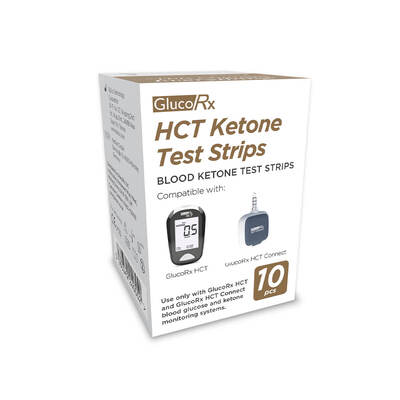
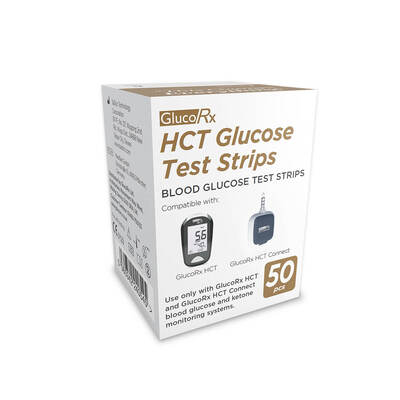
GlucoRx HCT Meter x1
Add to wish list
Create new list
GlucoRX HCT Blood Glucose & Ketone Meter
The GlucoRx HCT Meter is a multiparameter monitoring device suitable for use in primary care clinics supporting Type 1 diabetes management. The GlucoRx HCT Meter measures blood glucose, ketone, and haematocrit from a single device, using Haematocrit Correction Technology (HCT) and dual 2+2 Bio Signals to support reading accuracy across varied haematocrit levels.
Blood glucose results are returned in 5 seconds and ketone results in up to 10 seconds, from a sample volume of 1.0 µL for both tests. Measurement ranges are 0.5–35 mmol/L for glucose, 0.1–8.0 mmol/L for ketones, and 10–70% for haematocrit, supporting use across a range of clinical presentations.
The device supports three measuring modes — Gen (any time), AC (fasting ≥8 hours), and PC (post-meal 2 hours) — and includes a ketone warning alert at >1.5 mmol/L. A 1000-reading non-deletable memory with 7–90 day averages, PC download capability, and compatibility with Eclipse Telehealth and Diasend supports data management in clinical and self-management pathways.
The meter is suitable for use in newborns, pregnant women, and diabetic drivers, and is DVLA compliant. Each unit is supplied with batteries and an instruction manual.
Product Features
- Measures blood glucose, ketone, and haematocrit from a single device, reducing the need for multiple monitors
- Haematocrit Correction Technology (HCT) adjusts glucose readings across varied haematocrit levels, supporting reading consistency
- 1.0 µL sample volume required for glucose and ketone tests, supporting use in patients where sample availability is limited
- Glucose results in 5 seconds and ketone results in up to 10 seconds, supporting timely decision-making
- Three measuring modes (Gen, AC, PC) support structured monitoring across fasting, post-meal, and general clinical use
- Ketone warning alert at >1.5 mmol/L supports identification of clinically significant ketone levels
- 1000-reading non-deletable memory with 7–90 day averages supports patient review and longitudinal monitoring
- Compatible with Eclipse Telehealth and Diasend, supporting data transfer within digital diabetes care pathways
- DVLA compliant and suitable for use in newborns and pregnant women, supporting use across varied patient groups
- Backlit display, strip ejector, auto switch-off, and discreet buzzer support day-to-day usability in clinical and home settings
Product Specifications
- Brand: GlucoRx
- Device Type: Multiparameter blood glucose, ketone, and haematocrit meter
- Measurement Parameters: Blood glucose, ketone, haematocrit
- Glucose Range: 0.5–35 mmol/L
- Ketone Range: 0.1–8.0 mmol/L
- Haematocrit Range: 10–70%
- Sample Volume: 1.0 µL (glucose and ketone)
- Result Time: Glucose 5 seconds; ketone up to 10 seconds
- Measuring Modes: Gen, AC (fasting ≥8 hrs), PC (post-meal 2 hrs)
- Memory: 1000 readings, non-deletable; 7–90 day averages
- Data Connectivity: PC download; compatible with Eclipse Telehealth and Diasend
- Alerts: Ketone warning >1.5 mmol/L; 4 programmable alarms
- Dimensions: 96 x 61 x 26 mm
- Weight: 67.2 g
- Power: 2 x AAA batteries (included)
- Compliance: DVLA compliant
- Suitable Patient Groups: Adults, newborns, pregnant women, diabetic drivers
- In the Box: GlucoRx HCT Meter, batteries, instruction manual
Shop our range of Glucose Testing to support blood glucose testing across your practice.
Frequently Asked Questions
What is HCT on a glucose meter?
HCT on a glucose meter refers to haematocrit — the proportion of red blood cells in a given volume of blood, expressed as a percentage. According to GlucoRx, haematocrit levels affect the accuracy of blood glucose readings, as blood with a high or low red blood cell concentration can cause glucose results to read falsely high or low. Some meters use haematocrit‑compensation technology, which measures haematocrit and adjusts glucose readings to account for this variation, helping to maintain consistency across a wider range of haematocrit values. On these systems, the haematocrit result is intended to check that the sample is within the device’s acceptable range and is not used to diagnose conditions such as anaemia or erythrocytosis.
What level of HCT is concerning?
NHS clinical guidelines for polycythaemia indicate that a persistently raised haematocrit above 0.52 in men or above 0.48 in women warrants further investigation for polycythaemia or erythrocytosis. These thresholds are broadly consistent with NICE‑style guidance and typical laboratory reference ranges. Any raised haematocrit should be interpreted in combination with the full blood count, repeat measurements, and the person’s clinical history.
What conditions cause low HCT?
The NHS identifies several conditions associated with low haematocrit, including iron deficiency anaemia, vitamin B12 or folate deficiency, chronic kidney disease, and blood loss. Low haematocrit can also result from bone marrow disorders, chronic inflammatory or chronic disease states. Low haematocrit results should always be interpreted alongside the full blood count, repeat testing where appropriate, and the patient’s clinical history and examination findings.
Does high HCT mean dehydration?
High haematocrit can be associated with dehydration, as a reduction in plasma volume increases the concentration of red blood cells. The NHS notes that dehydration is one of several causes of raised haematocrit, alongside conditions such as polycythaemia vera and chronic hypoxia. A raised haematocrit result should be interpreted in clinical context, as multiple underlying causes are possible.
| Brand | Glucorx |