


Disposable Gloves Guide for Healthcare Professionals
Published: 01 September 2026
Introduction
Choosing the right medical gloves often comes down to three considerations:
• What the task involves.
• Whether you need a sterile barrier for protection.
• Which material best suits the person wearing the gloves.
On this page, we look at the differences between each type of medical glove, when you would go for one type over another (e.g. latex over vinyl), as well as some frequently asked questions.
Medical Gloves in Healthcare
These three varieties of medical glove cover most of what a practice uses on a daily basis.
Williams latex-free examination gloves are also powder-free and offer a high-quality medical glove at a low price.
They are suitable for routine patient contact where the task is short and the risk is low: for example, observations, assisting with dressing, and general handling.
The disposable gloves are latex-free and accelerator-free, making them suitable for professionals who have sensitive skin, or allergies of type I + IV.
Nitrile gloves offer more flexibility and provide better puncture and tear resistance over vinyl medical gloves. Nitrile stretches without losing its shape and stands up against a wider range of substances.
These qualities make nitrile gloves the go-to choice for most clinical procedures, especially for anything involving bodily fluids, and tasks where a glove failing mid procedure would have a knock-on effect.
SafeDon nitrile powder-free gloves come in packs of 200 rather than the typical 100 pack and have twin cuff first dispensers to ensure only one glove comes out at a time to avoid waste.
SafeDon nitrile gloves also feature a textured fingertip finish to provide better grip and tactile sensitivity.
When to use Vinyl Medical Gloves
Vinyl gloves are made from PVC. They typically fit more loosely than nitrile or latex gloves. They also have less elasticity and usually cost less per glove.
Vinyl medical gloves work well for short, low risk tasks: general patient handling, non-sterile procedures with no fluid exposure, food handling, and light cleaning.
Because they are latex-free, they are also suitable for practices managing latex sensitivities among staff or patients.
Where vinyl gloves fall is when it comes to sustained usage, or exposure to chemical and cytotoxics.
Vinyl gloves are more likely to develop micro breaches under heavy use compared to nitrile, and they don’t recover their shape when stretched.
If your task is expected to take more than a few minutes, or involves contact with fluids, that’s when it's time to switch to nitrile gloves.
Shop Vinyl Examination GlovesWhen to use Disposable Nitrile Gloves
Nitrile is a synthetic rubber and has become the default choice across most of UK healthcare for good reason.
Nitrile gloves resist punctures better than latex or vinyl, and they stretch and return to their original shape.
They also offer a barrier against a wider range of chemicals and contain no natural rubber latex proteins.
Typical use cases for nitrile gloves are clinical procedures, phlebotomy, wound care, handling of bodily fluids, laboratory work, and any situation where the glove needs to stay intact for the duration of the task.
Nitrile also gives a closer, second-skin fit than vinyl, which helps when the work needs dexterity.
Nitrile gloves usually come in either a blue or purple colour, so a breach shows up more visibly against your skin compared to a clear or cream glove, which is important when staff need to spot tears quickly.
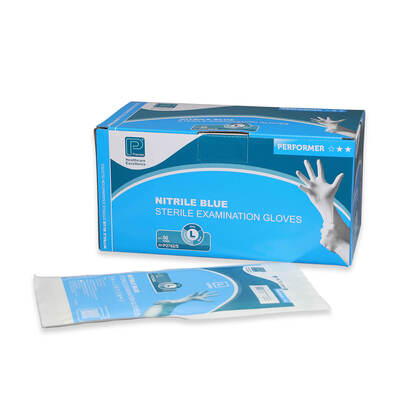
Nitrile gloves are available sterile and non-sterile for examination use or procedures needing an aseptic field.
Shop Medical Nitrile GlovesWhen to use Latex Medical Gloves
Natural rubber latex still gives the closest fit and the most tactile feel of any glove material.
For procedures needing precise control, some clinicians still choose latex gloves over other alternatives, and they remain widely used in surgery for that reason.
The main drawback with latex gloves is allergies.
Natural rubber latex contains proteins that can trigger Type I hypersensitivity in sensitised individuals, and reactions range from contact urticaria through to systemic responses.
This can affect both the wearer and the patient, and sensitivities can develop over time with repeated exposure rather than being present from the off.
Most UK healthcare settings have moved to latex-free as the standard choice for this reason, keeping latex for specific procedures where its properties are needed and where allergy status is known.
If your practice still stocks latex medical gloves, powder-free is the version to hold, and your latex allergy protocol should cover both staff and patients.
Shop Latex GlovesWhy Choose Latex-Free and Powder-Free Gloves?
Latex-free gloves remove the allergy risk from their latex equivalent. Nitrile and vinyl gloves are both latex-free, so a practice that stocks those two options doesn't need to stop and screen for latex sensitivity before a procedure.
Powder-free medical gloves are an option because of what the powder does once it is airborne.
Wearing powdered gloves, usually cornstarch, helps a glove be put on more easily.
But the powder doesn't stay on the glove. It drifts into the air when the gloves are removed, and it can settle in patient wounds and on your instruments.
In latex gloves, it acts as a vehicle for latex proteins, which is how powdered latex gloves came to be associated with sensitivities among staff who never even wore them.
Powder-free medical gloves are now the standard across UK healthcare. If you are still holding powdered stock, it is worth reviewing.
Shop Latex-Free GlovesWhen are Sterile and Surgical Gloves Needed?
What catches people out is that examination gloves and surgical gloves are different products, and not different sizes of the same thing.
Examination gloves are supplied non-sterile in boxes and are used for contact with intact skin, mucous membranes, and bodily fluids during routine care.
Surgical gloves are supplied sterile, packed in pairs, and are made with a separate left and right-hand design for a closer anatomical fit.
They have a longer cuff to overlap a gown sleeve, and are sized numerically rather than by letter, typically from 5.5 through to 9 in half sizes.
Sterile gloves are needed whenever a procedure involves entering a sterile body site or breaching the skin, such as surgery, invasive procedures, catheter insertion, and aseptic procedures where the glove will contact sterile equipment or an open wound.
Sterile gloves are available in both latex and synthetic materials.
Shop Surgeons and Sterile GlovesElbow Length and Long-Cuff Gloves
Standard examination gloves stop at your wrist. Long-cuff and elbow length gloves extend up the forearm, and they are used for tasks where contamination travels further than your hand.
Long-cuff and elbow length gloves are used in veterinary work, obstetrics and gynaecology, artificial insemination, some laboratory procedures, and deep cleaning tasks were reaching into a container, or cavity would otherwise expose your forearm.
The long-cuff also overlaps a gown sleeve, which closes the gap that a standard glove leaves.
| Vinyl Comfort | Nitrile | Safedon | |
|---|---|---|---|
| Best For | Routine everyday patient care | Clinical procedures | High volume clinical environments |
| Material | Comfort Vinyl (PVC) | Nitrile | Nitrile |
| Key features | Soft and comfortable | Strong, flexible and durable | Low cost per glove |
| Pack size | 100 | 100 | 200 |
| Latex Free | Yes | Yes | Yes |
| Order codes and sizes |
• D415S - Small • D415M - Medium • D415L - Large • D415XL - Extra Large |
• GLN100S - Small • GLN100M - Medium • GLN100L - Large • GLN100XL - Extra Large |
• D912SM - Small • D913 - Medium • D914 - Large • D915 - Extra Large |
How to Choose the Right Glove Size
The fit of your medical gloves affects both safety and comfort.
Gloves that are too tight are more likely to tear.
A glove that is too loose bunches at the fingers, reducing dexterity, and can catch or roll down during a task.
Examination gloves normally come in sizes S, M, L and XL, with XS and XXL available in some ranges.
Sizing is based on palm width. If you are between sizes, most clinicians size down for procedural work and up for tasks needing frequent changes.
Surgical gloves are sized numerically, from around 5.5 to 9.
The number corresponds roughly to the circumference of the palm in inches, measured across the knuckles excluding the thumb.
Size 7 to 7.5 sits in the middle of the range, which is what people usually mean when they ask for a medium surgical glove.
A correctly fitted glove should sit snugly across the palm with no slack at the fingertips, and it should not restrict movement or leave marks on your wrist.
If a box of gloves is causing you discomfort or hampering your work, check that the size is right for you.
What Standards do Medical Gloves Have to Meet in the UK?
Medical gloves sold for clinical use in the UK are regulated as medical devices.
They also fall under personal protective equipment when they are worn to protect the wearer from biological or chemical hazards.
That means a medical glove used in healthcare settings often needs to meet two sets of regulatory requirements at once.
EN 455 is the standard for single-use medical gloves, and it comes in four parts:
• Part 1 covers freedom from holes, tested to an acceptable quality level.
• Part 2 covers physical properties, including dimensions and the force needed to break the glove.
• Part 3 covers biological evaluation, including limits on residual powder, endotoxins and extractable protein.
• Part 4 covers how shelf life is determined and how the expiry date is arrived at.
EN 374 applies where gloves are used as protection against chemicals or micro-organisms.
If your staff handle cytotoxics, disinfectants or laboratory reagents, this is the standard to look for alongside EN 455.
UKCA and CE marking indicate the device has been assessed against the applicable requirements.
Sterile gloves sit in a higher device class than non-sterile gloves and carry a notified body number alongside the mark.
How Long Can Gloves be Worn, and How Should They be Disposed?
There is no fixed number of minutes.
The general rule of thumb is one task, one patient, one pair.
Gloves are changed between patients, and between a dirty step and a clean step on the same patient.
They are removed as soon as the task is finished, when touching notes, or handling equipment.
Wearing a single pair across multiple tasks moves contamination around rather than containing it.
Medical gloves are also not a substitute for hand hygiene.
Hands are decontaminated before putting gloves on and immediately after taking them off, because gloves can develop micro breaches during use, and your hands can become contaminated when removing them.
Prolonged wear also causes moisture build up inside the glove, and occlusion of the skin over long periods of time contributes to irritant contact dermatitis, which is far more common among healthcare staff than latex allergy.
Staff reporting sore or cracked hands are more often reacting to wear time and hand hygiene frequency than to the glove material itself.
Follow your local waste policy when disposing of medical gloves.
Gloves contaminated with infectious material go into the infectious waste stream, while gloves from routine care with no infectious risk go into the offensive waste stream. Neither goes in general waste.
Looking Beyond the Box Price
List price is the easiest to judge when determining how much medical gloves cost your practice, but pack size, the frequency of discarded gloves, failure rate, and time spent reordering are also consideration that need to be weighed up.
• Count per box: A box of 200 and a box of 100 are not comparable on shelf price. Divide the price by the count before comparing anything.
• Waste: Every glove that comes out of the box and does not go onto a hand is money in the bin. Dispensing systems that release one glove at a time exist for this reason, and in a high traffic room the difference adds up faster than most practices expect.
• Failure rate: A glove that tears during a procedure costs the replacement glove, the interruption, and in some cases the restart of the task. A material that holds up under the work it is doing is usually cheaper than one that does not, even at a higher unit price.
• Reordering: Larger counts mean fewer stock checks and fewer orders raised.
Work out your cost per glove, then weigh it against how the glove performs in the tasks you do daily.
The lower box price is sometimes the right answer. But it is worth checking rather than assuming.
Disposable Medical Gloves
Shop our range of disposable medical gloves for primary care.
-
£4.30 Save £0.55£3.75£4.50 inc VAT
-
£4.25£5.10 inc VAT
-
£6.70£8.04 inc VAT
-
 £25.80£30.96 inc VAT
Disposable Medical Gloves FAQs
Are nitrile gloves used in surgery?
Yes. Sterile nitrile surgical gloves are available and are used where a latex-free option is needed, either for the patient or for theatre staff. The material is not a barrier to surgical use, but the glove must be a sterile surgical glove rather than a nitrile examination glove.
Why are surgical gloves green or blue?
Two reasons. Colour contrast against blood and tissue reduces eye strain over a long procedure, since a coloured field prevents the visual afterimages that occur when staring at red against white. Colour is also used in double gloving, where a darker under glove shows through immediately if the outer glove is breached.
Are vinyl examination gloves latex-free?
Yes. Vinyl is made from PVC and contains no natural rubber latex. It is a suitable option for practices managing latex sensitivity, provided the task suits a vinyl glove.
Are surgical gloves supposed to be tight?
Snug, but not tight. A surgical glove should sit close across the palm with no slack at the fingertips, which is what gives the tactile feedback the procedure needs. If it restricts movement, leaves marks or causes hand fatigue, the size is too small.
How long are medical gloves good for?
Every box carries an expiry date, determined under part 4 of EN 455. Store boxes away from direct sunlight, heat and moisture, and rotate stock so older boxes are used first. Sterile gloves should not be used if the packaging is damaged, regardless of the date.
Can medical gloves cause skin irritation?
Yes, and it is common among healthcare staff. The usual cause is irritant contact dermatitis from prolonged wear, moisture inside the glove and frequent hand hygiene, rather than an allergy to the material. Latex allergy is a separate and less common condition. Persistent skin problems should be assessed through occupational health.
What kind of gloves do doctors and hospitals use?
Nitrile examination gloves for most routine clinical contact, sterile surgical gloves for invasive procedures, and vinyl for lower risk tasks. Most UK settings work latex-free as standard and keep latex for specific procedures.
| Glove type | Sterile | Latex-free | Strengths | Limitations | Typical use |
|---|---|---|---|---|---|
| Vinyl | No | Yes | Lowest cost per glove, easy donning, latex-free | Loose fit, low stretch recovery, weaker barrier under stress | Routine patient contact, short low risk tasks |
| Nitrile | Available in both | Yes | Puncture resistant, holds shape, wide chemical resistance, breach visible | Higher unit cost than vinyl | Clinical procedures, fluid exposure, laboratory work |
| Latex | Available in both | No | Closest fit, highest tactile sensitivity | Allergy risk to wearer and patient | Procedures needing fine control, where allergy status is known |
| Sterile surgical | Yes | Both available | Anatomical left and right fit, long-cuff, sterile barrier | Higher cost, single pair packaging | Surgery, invasive procedures, aseptic technique |
| Elbow length and long-cuff | Available in both | Yes | Forearm coverage, overlaps gown sleeve | Bulkier, higher cost | Veterinary, obstetrics, gynaecology, deep reach tasks |